GLP-1 Peptides for Weight Management: What the Science Says, Who Is a Candidate, and How Provena Does It Differently
A clinical guide to GLP-1 receptor agonists — semaglutide, tirzepatide — from Provena Care Miami. What the evidence shows, who is a candidate, side effects, and how medically supervised GLP-1 therapy differs from online prescribers.
PEPTIDESGLP-1SEMAGLUTIDEOZEMPICWEIGHT LOSSMETABOLIC HEALTHMIAMI
Aquiles Garcia-Menocal, APRN
5/19/20267 min read
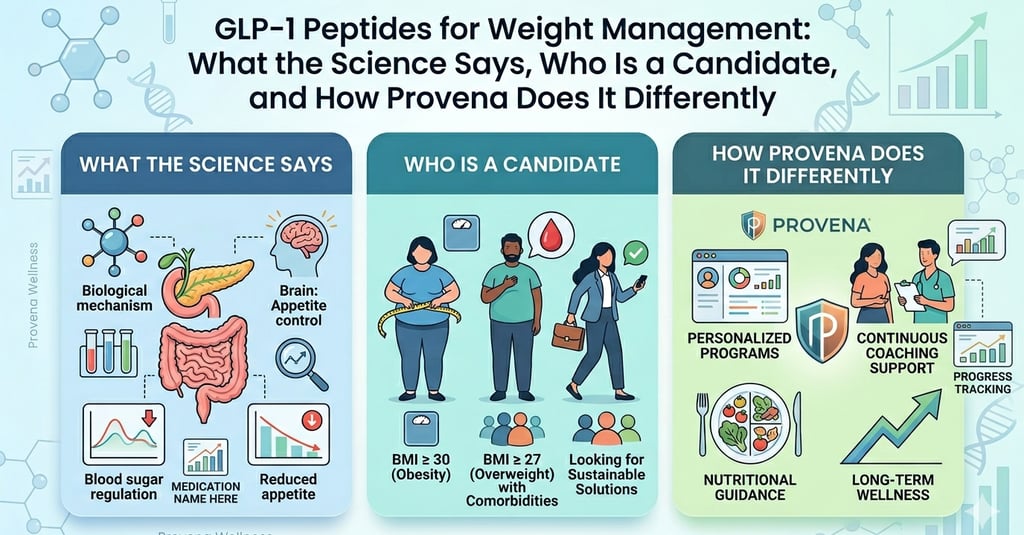
GLP-1 Peptides for Weight Management: What the Science Says, Who Is a Candidate, and How Provena Does It Differently
By Aquiles Garcia-Menocal, APRN — Lead Provider, Provena Care Peptide Therapy · Metabolic Health · Miami, FL
The Most Talked-About Drug in Medicine Right Now
GLP-1 receptor agonists — the class of medications that includes semaglutide (Ozempic, Wegovy) and tirzepatide (Mounjaro, Zepbound) — have fundamentally changed the conversation around obesity and metabolic disease. What was once a niche diabetes medication is now a cultural phenomenon, discussed in every doctor's office, every gym, and every dinner conversation in South Florida.
The attention is warranted. The clinical results from large randomized controlled trials are genuinely impressive — and not just for weight loss. GLP-1 agonists have demonstrated reductions in cardiovascular events, improvements in metabolic markers, and effects on inflammation and neurological function that researchers are still working to fully understand.
But the explosion in demand has also created a chaotic prescribing landscape: telehealth platforms dispensing semaglutide within minutes of sign-up, compounding pharmacies producing unapproved versions, and patients starting GLP-1 therapy with minimal evaluation, no nutritional guidance, and no monitoring for side effects or muscle loss.
This article explains what GLP-1 peptides actually do, what the evidence shows, who is and isn't a good candidate, and how Provena Care approaches GLP-1 therapy as a medically supervised component of a comprehensive metabolic health protocol — not a subscription box.
What Is a GLP-1 Receptor Agonist?
GLP-1 stands for glucagon-like peptide-1. It is a hormone naturally produced in the gut in response to eating. Its primary functions include:
Stimulating insulin secretion from the pancreas in response to elevated blood sugar
Suppressing glucagon (which would otherwise raise blood sugar)
Slowing gastric emptying — the rate at which food moves from the stomach to the small intestine
Signaling satiety to the brain — reducing appetite and food-seeking behavior
GLP-1 receptor agonists are synthetic molecules that bind to and activate the same receptors as naturally occurring GLP-1 — but with a much longer half-life than the native hormone, which is broken down within minutes of release.
The result is a sustained activation of GLP-1 pathways that produces meaningful reductions in appetite, improved blood sugar regulation, and — through a combination of reduced caloric intake and metabolic effects — significant weight loss in most patients who tolerate the medication.
What the Clinical Evidence Actually Shows
The evidence base for GLP-1 receptor agonists is among the strongest in metabolic medicine. Here are the key findings from major trials:
SUSTAIN and STEP Trials — Semaglutide
The STEP trials, which enrolled over 4,500 adults with obesity and no diabetes, demonstrated:
Average weight loss of 14.9% of body weight over 68 weeks with semaglutide 2.4mg weekly
A subset of participants lost more than 20% of body weight
Significant improvements in blood pressure, lipids, HbA1c, and inflammatory markers
Effects persisted throughout the trial duration but reversed after discontinuation
SURMOUNT Trials — Tirzepatide
Tirzepatide is a dual agonist — it activates both GLP-1 and GIP (glucose-dependent insulinotropic polypeptide) receptors. The SURMOUNT-1 trial demonstrated:
Average weight loss of up to 22.5% of body weight over 72 weeks at the highest dose
This approaches the weight loss outcomes seen with bariatric surgery in some patients
Significant improvements across all metabolic markers evaluated
SELECT Trial — Cardiovascular Outcomes
Perhaps the most consequential recent finding: the SELECT trial demonstrated that semaglutide 2.4mg significantly reduced major cardiovascular events (heart attack, stroke, cardiovascular death) in adults with obesity and established cardiovascular disease — a 20% relative risk reduction.
This established GLP-1 therapy not just as a weight loss tool but as a cardiovascular disease treatment — a designation with profound implications for how this class of medication is used in clinical practice.
The Side Effect Profile — What Patients Actually Experience
GLP-1 agonists are not without side effects, and any provider who doesn't discuss them candidly before prescribing is doing their patients a disservice.
Gastrointestinal Effects — The Most Common Issue
Nausea, vomiting, constipation, and diarrhea are the most frequently reported side effects. They occur primarily during dose escalation — the period when the medication dose is being gradually increased toward the therapeutic target. For most patients, GI side effects are manageable and improve significantly once a stable dose is reached.
Strategies that help: slow dose escalation, eating smaller meals, avoiding high-fat or high-sugar foods, staying well hydrated, and taking the injection on a day when schedule flexibility allows.
Severe, persistent GI symptoms that don't improve warrant dose reduction or medication adjustment.
Muscle Mass Loss — The Underaddressed Problem
This is the most important clinical concern that most GLP-1 prescribers do not adequately address.
The weight loss produced by GLP-1 therapy comes from reduced caloric intake — and reduced caloric intake without adequate protein and resistance training produces loss of both fat mass and lean muscle mass. Studies have found that a meaningful proportion of weight lost on GLP-1 therapy — estimates range from 25–40% — can be lean mass rather than fat mass if dietary and exercise habits are not optimized.
Loss of lean muscle mass during weight loss has downstream consequences: reduced metabolic rate, impaired physical function, increased frailty risk in older adults, and greater likelihood of weight regain upon discontinuation.
At Provena, we address this directly. Every patient on GLP-1 therapy receives guidance on protein targets (generally 1.0–1.2 grams per pound of lean body mass), resistance training recommendations, and monitoring of body composition — not just weight on a scale.
Pancreatitis Risk
GLP-1 agonists carry a small but real risk of pancreatitis. Patients with a personal or family history of pancreatitis or thyroid cancer (medullary type) are not candidates for GLP-1 therapy. This is why a clinical evaluation before prescribing — including a detailed medical history — is non-negotiable.
Gallbladder Issues
Rapid weight loss of any kind increases the risk of gallstone formation. GLP-1-associated weight loss is no exception. Patients with existing gallbladder disease should discuss this risk explicitly before starting therapy.
Who Is a Good Candidate for GLP-1 Therapy at Provena?
We evaluate candidacy based on the following criteria — not a brief online questionnaire.
You may be a good candidate if:
Your BMI is 30 or above (obesity), or 27 or above with at least one weight-related comorbidity (hypertension, type 2 diabetes, dyslipidemia, cardiovascular disease, sleep apnea)
You have made genuine attempts at lifestyle modification without achieving or maintaining meaningful results
Your metabolic lab work shows insulin resistance, elevated HbA1c, or other markers consistent with metabolic dysfunction
You have no contraindications — personal or family history of medullary thyroid cancer, MEN2 syndrome, pancreatitis, or severe GI disease
You are committed to the dietary and exercise components that maximize results and minimize muscle loss
You are likely not a good candidate if:
Your BMI is below 27 and you have no metabolic comorbidities — the risk-benefit calculation does not support GLP-1 therapy for cosmetic weight loss in metabolically healthy individuals
You have significant GI disease, history of pancreatitis, or relevant family history
You are pregnant or planning to become pregnant
You are seeking a medication without committing to the lifestyle components that make it clinically meaningful
How Provena Care Approaches GLP-1 Therapy Differently
The availability of GLP-1 medications through telehealth platforms with minimal evaluation has created a two-tier reality: patients who receive careful, medically supervised therapy and patients who receive a prescription with no clinical infrastructure around it.
The difference in outcomes between these two groups is not trivial.
At Provena, GLP-1 therapy is integrated into a comprehensive metabolic protocol:
Before starting: We evaluate your metabolic labs (fasting glucose, fasting insulin, HbA1c, lipid panel with ApoB, liver enzymes, thyroid function, complete metabolic panel), medical history, contraindications, and goals. We establish a baseline body composition picture — not just weight.
Dose escalation: We guide you through the escalation schedule carefully, monitoring for side effects and adjusting pace based on your tolerance. We do not rush to maximum dose.
Nutritional protocol: Every GLP-1 patient at Provena receives specific protein targets and general dietary guidance to maximize fat loss and preserve lean muscle. GLP-1 reduces appetite — what you choose to eat within that reduced appetite window determines whether you lose fat, muscle, or both.
Exercise integration: Resistance training is not optional. We discuss it at every visit because it is the primary tool for preserving lean mass during caloric restriction.
Monitoring: Follow-up labs, body composition assessment, and clinical check-ins are built into the protocol — not left to the patient to initiate if they notice a problem.
Discontinuation planning: GLP-1 therapy is not indefinitely required in all patients. For some, it is a time-limited tool to achieve metabolic reset. For others, it is long-term management. We plan for both scenarios from the beginning.
GLP-1 and Testosterone — The Interaction Worth Understanding
For male patients at Provena who are on both GLP-1 therapy and testosterone replacement, this intersection deserves specific attention.
Weight loss — particularly visceral fat reduction — independently improves testosterone levels. Adipose tissue is a major site of testosterone aromatization (conversion to estradiol), so reducing fat mass reduces estrogen load and can meaningfully improve free testosterone even without changing the TRT protocol.
As body composition improves on GLP-1 therapy, TRT dosing may need adjustment. We monitor hormone panels more frequently in patients on combined protocols to ensure optimal hormonal status as body composition changes.
The Compounded Semaglutide Question
During the recent period of branded GLP-1 shortages, compounding pharmacies were permitted to produce compounded versions of semaglutide. As of early 2025, the FDA has declared the shortage resolved and has moved to restrict compounded GLP-1 production.
Compounded medications are not FDA-approved and are not subject to the same quality controls as branded products. At Provena, we work with FDA-approved formulations when available and discuss the current regulatory landscape with patients transparently — because what was available six months ago may not be the same as what is available today.
The Bottom Line
GLP-1 receptor agonists are among the most clinically significant therapeutic advances in metabolic medicine in decades. The evidence for their efficacy — for weight loss, metabolic improvement, and cardiovascular risk reduction — is robust and growing.
They are also not appropriate for everyone, not without risks, and not effective in isolation. The patients who achieve the best outcomes are those who receive careful clinical evaluation before starting, thoughtful management during therapy, and a comprehensive lifestyle protocol that treats the medication as a tool — not the solution.
If you are considering GLP-1 therapy and want to understand whether you are a good candidate, what your labs show, and how to structure the protocol for maximum results and minimum muscle loss, that is exactly the conversation we have at Provena Care.
Provena Care 10251 SW 72nd St, Suite 106 · Miami, FL 33173 305.395.7108 · info@provenacare.com
Peptide therapy protocols including GLP-1 management are available to all Provena patients. Members receive 10–40% discounts on peptide therapies depending on tier. View membership plans.