Why You're Aging Faster Than You Think: The Hallmarks of Aging Explained
This article draws on research and clinical insights from David Sinclair, PhD (Harvard Medical School, Lifespan, The Lifespan Podcast), and Peter Attia, MD (Outlive, The Drive Podcast). It is for educational purposes and does not constitute medical advice. Please consult a licensed healthcare provider before making changes to your health regimen.
LONGEVITY MEDICINEHALLMARKS OF AGINGBIOLOGICAL AGEDAVID SINCLAIRPATER ATTIA, MDANTI-AGINGHORMONE THERAPYPEPTIDE THERAPYNAD+PROVENA CAREPRIMARY CAREFUNCTIONAL MEDICINE
Provena Care Clinical Team
6/2/20267 min read


Your Biological Clock Is Running — But You Can Change the Speed
Most of us grew up believing aging was like a slow, inevitable tide — something that happens to you, not with you. You hit your 40s, your energy dips. You reach your 50s, and suddenly recovery from a weekend hike takes longer than the hike itself. You see your parents and think: Is this just what happens?
Science now says: not necessarily.
Over the past two decades, researchers like David Sinclair, PhD, professor of genetics at Harvard Medical School and author of Lifespan: Why We Age — and Why We Don't Have To, have fundamentally changed how medicine thinks about aging. And Peter Attia, MD — one of the foremost longevity physicians in the world and host of The Drive podcast — has spent years translating that science into clinical practice.
Their central message: aging is not a fixed program. It is, in large part, a collection of biological processes — many of which are measurable, addressable, and in some cases reversible.
At Provena Care, we take this science seriously. Our membership model exists precisely because traditional primary care is built to treat disease — not to prevent it, optimize against it, or help you age on your own terms. This article breaks down the biology of aging, explains what drives it, and shows what you can actually do about it.
What Are the Hallmarks of Aging?
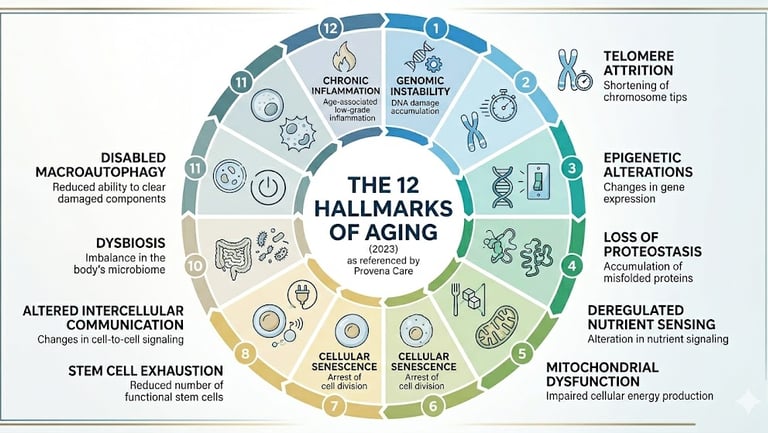
In 2013, a landmark paper published in the journal Cell — later updated in 2023 — identified the core biological processes that drive aging across virtually all species. These are called the Hallmarks of Aging. Think of them as the root causes beneath every gray hair, stiff joint, and sluggish morning.
The 2023 update expanded the original list to 12 hallmarks. Understanding them is the first step to understanding why two people of the same age can look and feel dramatically different — and why one of them might be biologically 10 years younger than the other.
The 12 Hallmarks of Aging
1. Genomic Instability
Your DNA accumulates damage over your lifetime from UV radiation, oxidative stress, toxins, and replication errors. Your body has repair mechanisms — but over time, they can't keep up. Sinclair describes this as the central driver of aging: the body losing information stored in the epigenome.
What you feel: Increased cancer risk, reduced cellular function.
2. Telomere Attrition
Telomeres are the protective caps on the ends of your chromosomes — like the plastic tips on shoelaces. Every time a cell divides, telomeres shorten. When they become too short, cells stop dividing and become senescent (more on that below). Peter Attia tracks telomere length as a biomarker of biological age in his practice.
What you feel: Accelerated aging in high-turnover tissues — skin, gut lining, immune cells.
3. Epigenetic Alterations
This is David Sinclair's specialty. Your epigenome is the system of chemical tags that tell genes when to turn on and off. Over time, these tags become dysregulated — like a music player that starts skipping songs or playing them in the wrong order. Sinclair's "Information Theory of Aging" proposes that restoring epigenetic information is the key to reversing biological age.
What you feel: Gene expression becomes disorganized; tissue function declines.
4. Loss of Proteostasis
Your cells are constantly making proteins, using them, and breaking down old or misfolded ones. As we age, this quality control system — called proteostasis — starts to fail. Misfolded proteins accumulate, which is directly linked to Alzheimer's disease, Parkinson's disease, and other age-related conditions.
What you feel: Cognitive decline risk, neurodegenerative disease.
5. Disabled Macroautophagy
Autophagy is your cells' self-cleaning system. It breaks down damaged organelles, recycles cellular debris, and keeps everything running efficiently. As we age — and particularly with poor diet, sedentary behavior, and chronic overeating — autophagy slows down. Peter Attia discusses autophagy extensively in the context of fasting and metabolic health.
What you feel: Accumulation of cellular "junk," reduced energy, immune dysfunction.
6. Deregulated Nutrient Sensing
Your cells have built-in sensors for nutrients — primarily through pathways like mTOR, AMPK, and insulin/IGF-1 signaling. In youth, these systems are tightly regulated. With age (and often high-calorie, low-activity lifestyles), they become dysregulated. The mTOR pathway, when chronically activated, accelerates aging. AMPK, when activated through exercise and caloric restriction, promotes longevity.
What you feel: Metabolic dysfunction, insulin resistance, weight gain.
7. Mitochondrial Dysfunction
Mitochondria are your cellular power plants — they produce ATP, the energy currency of every cell. Aging impairs mitochondrial function, leading to less energy, more oxidative stress, and a cascade of downstream problems. This is one reason NAD+ has become so important in longevity medicine: NAD+ is essential for mitochondrial function, and levels decline dramatically with age.
What you feel: Fatigue, reduced exercise capacity, cognitive fog.
8. Cellular Senescence
As cells age or sustain damage, some enter a state called senescence — they stop dividing but don't die. These "zombie cells" accumulate and release inflammatory molecules (called the SASP — senescence-associated secretory phenotype) that damage neighboring healthy cells. Attia calls senescent cell burden one of the most important — and under-discussed — drivers of age-related disease.
What you feel: Chronic, low-grade inflammation ("inflammaging"); joint pain; tissue degeneration.
9. Stem Cell Exhaustion
Your body relies on stem cells to regenerate tissues — muscle, bone marrow, gut lining, skin. With age, stem cell populations decline, and the ones that remain are less functional. This is why recovery slows, why wounds heal more slowly, and why muscle mass becomes harder to maintain after 40.
What you feel: Slower recovery, reduced regenerative capacity, muscle loss.
10. Altered Intercellular Communication
Cells constantly send signals to each other via hormones, cytokines, and other molecules. Aging disrupts this communication network — hormones decline (testosterone, estrogen, growth hormone, DHEA), inflammatory signaling increases, and cellular coordination breaks down. This is the foundation of much of what we treat with hormone therapy and peptide protocols at Provena Care.
What you feel: Hormonal symptoms, systemic inflammation, reduced resilience.
11. Chronic Inflammation (Inflammaging)
This hallmark — added in the 2023 update — reflects how low-grade, persistent inflammation is both a cause and consequence of aging. Unlike acute inflammation (which heals you), chronic inflammation quietly damages tissues, accelerates the other hallmarks, and is now recognized as a root driver of cardiovascular disease, dementia, diabetes, and cancer.
What you feel: Fatigue, aches, metabolic issues, elevated CRP on labs.
12. Dysbiosis
Also added in 2023. Your gut microbiome — the trillions of bacteria, fungi, and viruses that live in your digestive tract — changes dramatically as you age. Diversity drops, beneficial species decline, and inflammatory species proliferate. Rhonda Patrick's research has highlighted how strongly the microbiome influences systemic inflammation, immune function, brain health, and longevity.
What you feel: Digestive issues, immune dysregulation, increased systemic inflammation.
Why Some People Age Faster Than Others
Here's the key insight Sinclair and Attia both emphasize: the hallmarks of aging are not equally distributed. Your chronological age — the number on your driver's license — tells you very little about how old you actually are biologically.
Biological age is driven by a complex interaction of:
Genetics — roughly 20-30% of longevity is heritable, according to research Sinclair cites
Lifestyle — sleep quality, exercise, diet, stress management
Environmental exposures — toxins, UV, pollutants
Hormonal status — testosterone, estrogen, cortisol, insulin, growth hormone
Metabolic health — insulin sensitivity, visceral fat, chronic inflammation markers
Gut health — microbiome diversity and composition
The good news: the modifiable factors account for the majority. Sinclair's own research on epigenetic reprogramming in mice has demonstrated that biological aging is, at least in principle, reversible. While full epigenetic reprogramming is not yet clinical practice in humans, the interventions that slow and mitigate the hallmarks absolutely are.
What You Can Do Right Now: Evidence-Based Interventions
Peter Attia organizes longevity medicine around four pillars. Each one directly targets one or more of the hallmarks above.
Pillar 1: Exercise
No single intervention targets more hallmarks than exercise. Attia argues it is the most potent longevity drug we have — particularly zone 2 cardio (for mitochondrial biogenesis) and strength training (for muscle mass and stem cell health). Research consistently shows that cardiorespiratory fitness (measured by VO2 max) is one of the strongest predictors of all-cause mortality.
Hallmarks targeted: Mitochondrial dysfunction, stem cell exhaustion, metabolic deregulation, inflammation, cellular senescence.
Pillar 2: Nutrition and Metabolic Health
Both Attia and Sinclair emphasize caloric awareness, protein adequacy, and minimizing ultra-processed foods. Time-restricted eating and periodic fasting activate autophagy and AMPK. Adequate protein intake (Attia recommends 0.7–1.0g per pound of body weight) preserves muscle mass against stem cell exhaustion and sarcopenia.
Hallmarks targeted: Autophagy, deregulated nutrient sensing, mitochondrial dysfunction, inflammation.
Pillar 3: Sleep
Attia calls sleep "the most underrated performance-enhancing drug." Deep sleep is when your glymphatic system clears amyloid plaques from the brain — directly protecting against proteostasis failure. Consistent sleep (7-9 hours, with stable timing) regulates cortisol, reduces inflammatory markers, and supports cellular repair.
Hallmarks targeted: Proteostasis, genomic instability, altered intercellular communication, chronic inflammation.
Pillar 4: Medications and Supplements — Targeted Therapeutics
This is where clinical longevity medicine enters. At Provena Care, we offer a range of evidence-informed interventions that directly target the hallmarks:
NAD+ IV Therapy — replenishes depleted NAD+ to support mitochondrial function and sirtuin activation
Hormone Optimization — testosterone replacement therapy (TRT), peptide hormones — corrects declining intercellular communication
Peptide Therapy — BPC-157, CJC-1295, TB-500 — supports healing, growth hormone signaling, tissue repair
IV Nutrient Therapy — Myers Cocktail, Glutathione — reduces oxidative stress and supports cellular repair
The Provena Care Approach: Primary Care Meets Longevity Medicine
Traditional primary care is reactive. You come in when something is wrong, you get a diagnosis, you get a prescription. That model is essential — and we provide it. But it misses the window when the most impactful work can be done: the decades before disease appears.
Our membership model gives you access to a different kind of medicine. We measure your biological age markers — telomere length, epigenetic clocks, inflammatory panels, hormonal status, metabolic markers — and we build a personalized protocol to address them. The hallmarks of aging aren't abstract science to us. They're the checklist we work through with every patient.
Whether you're someone who has been sick and wants to take back control, a health-conscious individual looking to optimize, or someone who simply wants both — we built Provena Care for you.
Frequently Asked Questions
Q: Can aging actually be reversed, not just slowed?
David Sinclair's research — including his 2023 paper in Aging journal — has demonstrated biological age reversal in animal models using epigenetic reprogramming. In humans, lifestyle interventions have shown measurable reductions in epigenetic age. Full reversal is not yet clinical reality, but slowing and partial reversal are.
Q: How do I find out my biological age?
Biological age can be assessed through several validated tools: epigenetic clocks (like the GrimAge or DunedinPACE clocks based on DNA methylation), telomere length testing, and comprehensive metabolic/inflammatory panels. We offer these assessments at Provena Care.
Q: Is longevity medicine only for wealthy people?
Attia acknowledges this concern directly. Many of the most impactful interventions — exercise, sleep, diet — are free or low-cost. The clinical interventions (hormone therapy, peptides, IV therapy) add value on top of a strong foundation. Our membership model is designed to make proactive medicine accessible and affordable on an ongoing basis.
Q: What's the single most important thing I can do today?
Both Sinclair and Attia would say: start exercising if you don't already, and protect your sleep. The data on cardiorespiratory fitness as a predictor of longevity is as strong as any biomarker in medicine.
Ready to Know Your Biological Age?
The hallmarks of aging are happening in your body right now. But how fast they're progressing — and what you can do about them — is something we can measure, discuss, and act on together.